Short answer. Across the 52 fire alarm maintenance contracts we invoiced in the twelve months to September 2026, the median price was £304 a year, excluding VAT. Half of the sites paid between £216 and £505. A single pharmacy branch paid £150. A large industrial site with four service visits a year paid £3,223. Alarm monitoring, call-outs and parts are charged on top.
This article uses our own contracts, so you can compare your quote with what similar premises in Norfolk, Suffolk and Cambridgeshire actually pay.
Where these figures come from
We took typical Hawthorne sales invoices over the last 12 months and separated out the fire alarm maintenance charges from everything that is usually billed alongside them: intruder alarms, CCTV, emergency lighting, extinguishers and monitoring. The headline figures use the 52 fire-alarm-only contracts invoiced in the last twelve months. We then checked them against the servicing quotes in our job management system, and against the service reports our engineers wrote between May 2025 and August 2026.
All prices exclude VAT. Customer names are withheld.
What our customers pay
| Annual fire alarm maintenance charge | Number of sites (latest price per site, 96 sites, excluding contracts marked as multi-visit) |
|---|---|
| Under £150 | 7 |
| £150 to £249 | 26 |
| £250 to £349 | 27 |
| £350 to £499 | 19 |
| £500 to £999 | 14 |
| £1,000 and over | 3 |
79 of those 96 sites paid less than £500 a year. The sites above £500 are mostly larger buildings, blocks with more than one system, or sites with more frequent visits.
Prices by type of premises
| Premises | Annual fire alarm maintenance (net of VAT) |
|---|---|
| Pharmacy branch | £150 |
| Small shop | £126 to £132 |
| Builders' merchant branch | £265 |
| Dental practice | £294 to £369 |
| Office or professional services | £289 to £294 |
| Childcare | £293 |
| Pub | £228 to £509 |
| Hotel building | £419 |
| Supermarket | £375 to £696 |
| Industrial or manufacturing unit | £164 to £656 |
| Managed residential block | £168 to £288 |
| Larger residential or mixed-use block | £545 to £1,442 |
| Large industrial site, 4 visits a year | £1,611 to £3,223 |
What actually changes the price
The number of visits. BS 5839-1:2025 recommends an inspection and service roughly every six months. Where a 2026 quote states the visit count, two-visit contracts were quoted at £354 to £465. Some sites need more. Our two largest industrial sites are serviced four times a year.
The size of the system. Every detector, call point, sounder and interface has to be tested. A system with 20 devices and a system with 200 are different jobs.
Addressable panels and larger sites. Addressable systems let the engineer read each detector's condition from the panel. That helps the engineer find contaminated or failing detectors before they cause a false alarm.
Interfaces. Door holders, lift homing, smoke vents, sprinkler flow switches and alarm receiving centre signalling all have to be proved at the service visit.
Access. Hotel bedrooms, occupied flats, secure areas and ceiling voids all add time, because every device has to be reached and tested during the year.
Whether it is bundled. Many of our customers have their fire alarm serviced on the same contract as intruder alarms, CCTV, emergency lighting or extinguishers, so one visit can cover several systems.
Monitoring is a separate cost
If your fire alarm signals to an alarm receiving centre, that is charged separately from servicing. On our current contracts:
- a basic signalling path for a fire alarm costs £50 to £100 a year
- fire alarm monitoring contracts cost £150 to £350 a year
Whether you need monitoring depends on your fire risk assessment, your insurer and whether the building is occupied at night. Residential care premises are a special case: BS 5839-1:2025 now treats missing remote monitoring there, where it is needed, as an unacceptable variation.
In Norfolk, monitoring has a particular job to do. Norfolk Fire and Rescue Service does not send an automatic emergency response to an automatic fire alarm at industrial or commercial premises, offices, shops, licensed premises with no sleeping risk, places of worship or public buildings, at any time of day, unless someone on site confirms a fire or a smell of smoke or burning. A signal to an alarm receiving centre will not bring a fire engine on its own. What monitoring does is get a keyholder or an engineer to the building quickly, so someone can confirm whether there is a fire.
Call-out and repair costs
Servicing covers the planned visits. Faults and false alarms are charged when they happen.
Our fire alarm call-outs in 2025 and 2026 typically cost about £100 to £200, depending on how urgent the visit was and whether it was out of hours. Parts are charged on top. A standby battery for the panel is usually under £60, and a replacement detector, call point or sounder typically costs £150 to £350 fitted.
A real example. In April 2025 the alarm receiving centre called us to an activation at a residential building. Our engineer traced it to a smoke detector in the car park that was full of dust and debris, and recommended replacing it. A year later the same detector set the system off again. The second call-out and the replacement detector came to under £300 between them. Cleaning a contaminated detector can buy time, but on this site it did not solve the problem.
What service visits actually find
Between May 2025 and August 2026 our engineers wrote detailed findings on 82 fire alarm service visits across 55 sites. These were the problems they recorded most often.
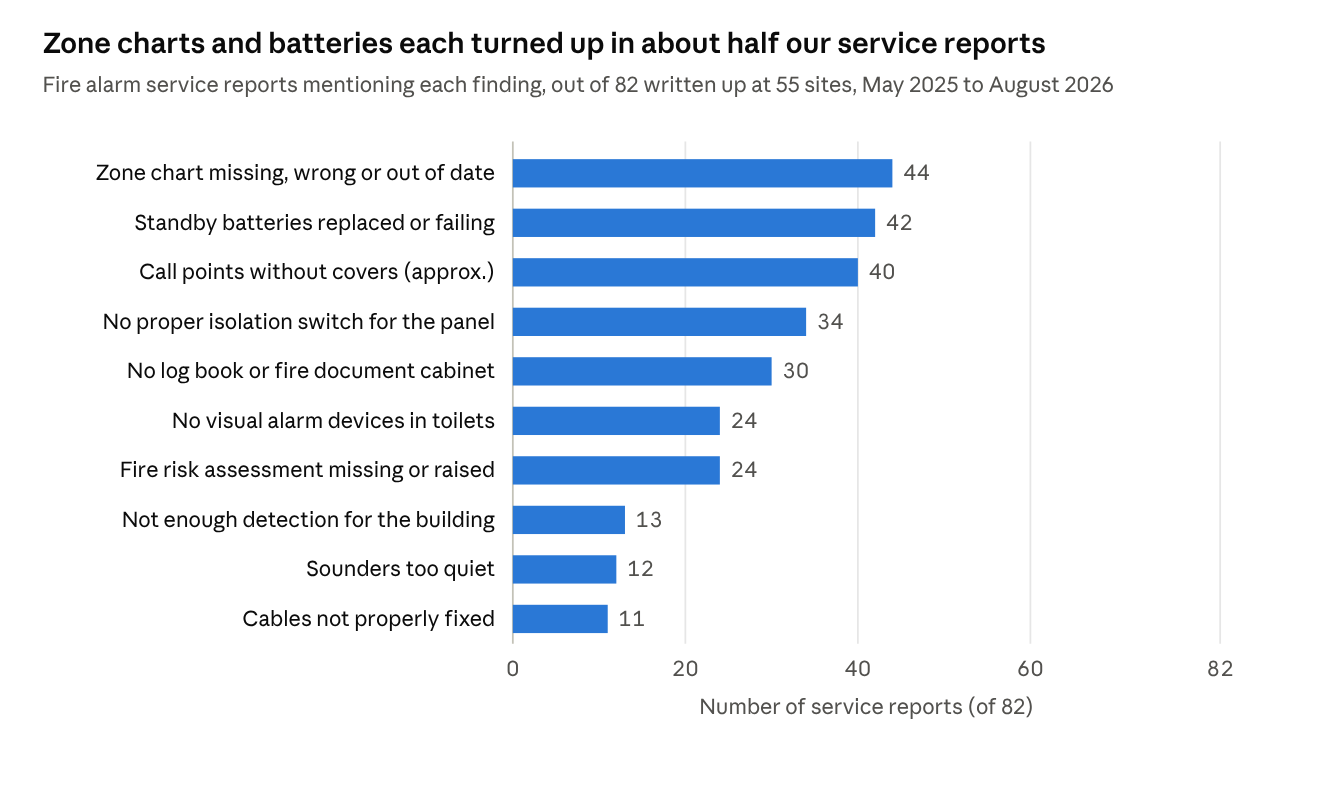
This is a list of common failings based on what is frequently reported. The vast majority of systems have no issues, but these are not represented in the chart or the numbers.
Most of these are cheap to put right. In 2026 a typical set of paperwork-and-covers remedials (a zone chart, a log book and cabinet, a proper isolation switch and call point covers) cost our customers £450 to £800. The expensive findings are the ones that point to a system reaching the end of its life: detectors more than ten years old, wiring that was never fire-rated, or a building that has changed around the system.
Two of these need a discussion:
- Call point covers are sometimes described to customers as a new 2025 requirement. BS 5839-1 has in fact recommended protective covers on all manual call points since the 2017 edition, to cut accidental activations.
- The zone chart is now more serious than it was. Under BS 5839-1:2025, in premises with more than one zone, leaving out a zone plan at the control panel is classed as an unacceptable variation. If your service provider has never mentioned it, ask why.
What a service visit should include
Under BS 5839-1:2025, a routine inspection and service should include:
- checking the log book and reviewing any false alarms since the last visit
- testing every detector, call point and sounder over the course of the year, with each device tested at least once a year
- checking that alarm signals reach the alarm receiving centre, where the system is monitored
- checking and adjusting any time clock on the panel, which matters on systems with day and night settings
- testing the standby batteries and the charger
- testing interfaces such as door holders and lift homing
- at the twelve-monthly visit, functional testing of smoke detectors in ventilation ducts, where fitted
- a written record of the visit, and an inspection and servicing certificate
Our article on how often a fire alarm should be tested and serviced sets out the full schedule.
Can we do the weekly test for you?
The weekly test is the responsible person's job, and it takes a few minutes. Some buildings have nobody suitable on site, so we do it for them. A weekly test visit typically costs £45 to £90, depending on what else is tested on the same visit.
Will the price go up every year?
We review prices once a year, at renewal.
Switching to a new provider
If you move your servicing to us from another company, the first visit takes longer. We have no history for the system, the panel codes may not have been handed over, and the paperwork is often incomplete. The first visit therefore costs more, prices start from just £100 for a takeover visit on its own to a few hundred pounds when it is combined with a full first service.
How to get a price
Tell us what is on site: the panel make, roughly how many devices, and whether the system is monitored. We can usually give an indicative maintenance price over the phone for a straightforward building, and we will quote in writing after the first visit if the system turns out to be different from what was described. On these visits we provide you with a free compliance check of your system so you can make an informed decision on what (if anything) is needed.
Call 01603 425100 or ask for a servicing quote. We cover Norfolk, Suffolk, Cambridgeshire and the South East.
Frequently asked questions
How much does a fire alarm service cost in the UK?
We surveyed 52 of Hawthorne's contracts in East Anglia, the median annual fire alarm maintenance charge was £304 excluding VAT, and half of sites paid between £216 and £505 a year. Monitoring, call-outs and replacement parts are extra.
How much does it cost to have a fire alarm serviced once?
Our contracts are annual. A one-off visit to take over and service an existing system typically costs a few hundred pounds.
Is fire alarm servicing a legal requirement?
The Regulatory Reform (Fire Safety) Order 2005 requires the responsible person to keep fire safety equipment maintained in efficient working order. BS 5839-1 is the recognised standard for how to do that for a fire alarm, and it recommends a service about every six months.
Can an electrician service a fire alarm?
Anyone who services a fire alarm should be competent in BS 5839-1, which is a different discipline from general electrical work under BS 7671. Ask for evidence of fire alarm training and experience, and for examples of systems they already service.
What does a fire alarm call-out cost?
Our fire alarm call-outs in 2025 and 2026 typically cost about £100 to £200 excluding VAT, depending on how urgent the visit was and whether it was out of hours. Parts are extra.
About the author. Dr Andrew Threadgold is Co-Owner of Hawthorne, a commercial security and fire protection company based in Norwich. The technical content of this article was reviewed by Ashley Smith, Hawthorne's lead engineer. Prices are taken from Hawthorne's own invoices and quotes and were last reviewed on 27 September 2026.
Sources: Norfolk Fire and Rescue Service, automatic fire alarms. Fire Industry Association, Guide to the changes in BS 5839-1:2025. Fire Industry Association, covers on manual call points, 2017.