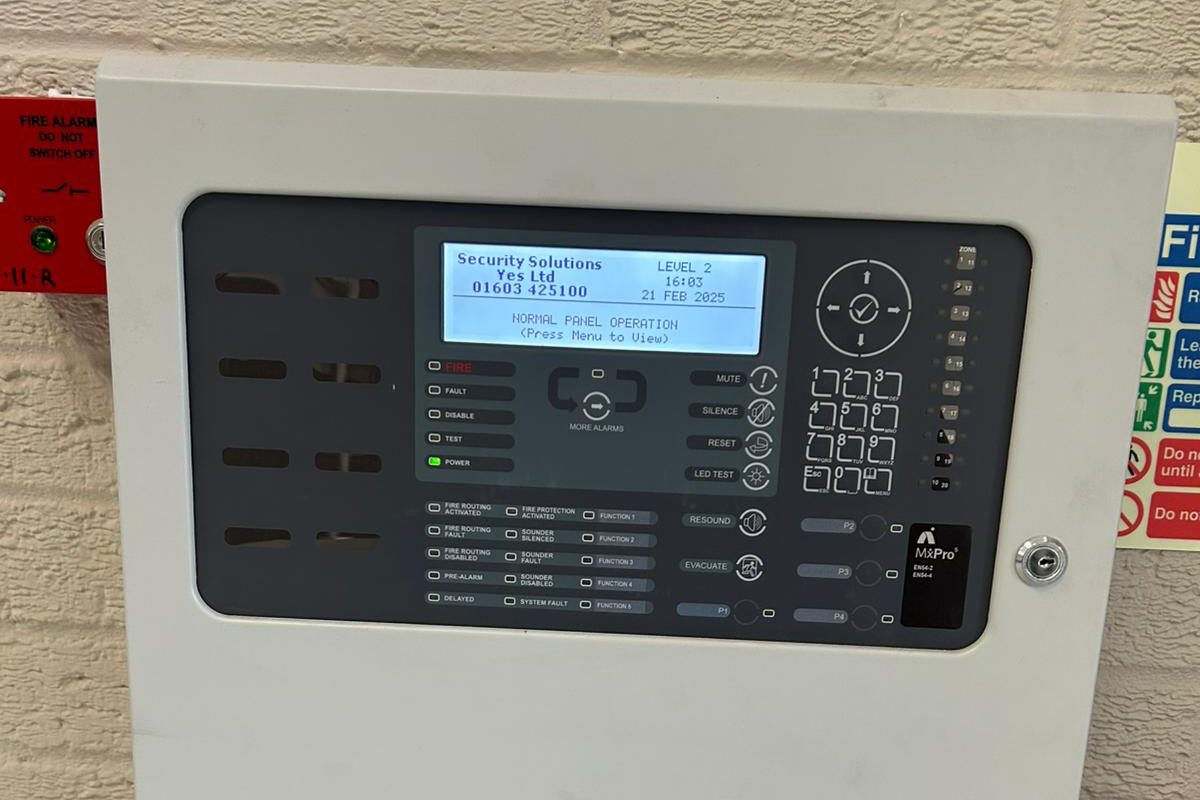
Short answer. Across the fire alarm installation and upgrade work we invoiced recently, adding or replacing a few detectors or call points on an existing system cost £388 to £880. A replacement control panel cost £449 to £674. A new or replacement system for a small business unit, a small retail premises or a block of three flats cost £2,500 to £3,000. A full upgrade or new addressable system for a mid-sized commercial building cost £10,000 to £11,300. A large fire installation for an industrial site came to £73,668. All figures exclude VAT.
Every figure here comes from Hawthorne's own invoices and quotes. The rest of this article explains what sits behind them, so you can work out where your building is likely to land.
Where these figures come from
In September 2026 we went through every sales invoice Hawthorne issued recently, up to September 2026, and pulled out every line that related to fire safety work: fire alarms, and also emergency lighting, extinguishers and fire risk assessments. That produced 933 invoice lines across 615 invoices. This article uses the fire alarm installation and upgrade work within that set. We then checked them against the fire alarm quotes held in our job management system. All anonymised, naturally.
Invoice prices are what the customer paid. Quote prices are what we offered. Both are shown net of VAT and include design, materials, labour, commissioning and certification unless we say otherwise.
What we actually charged, by size of job
| Type of job | What we invoiced (net of VAT) | Examples from our invoices |
|---|---|---|
| Adding or replacing detectors or call points on an existing system | £388 to £880 | A new smoke detector plus relocating another, £388. 3 devices, £486. 4 smoke detectors in refurbished offices, £657. Replacing call points and smoke detectors in a residential block, £880 |
| Replacement control panel | £449 to £674 | Three separate panel replacements, 2024 |
| Additional detection or partial upgrade | £1,259 to £2,468 | 5 optical smoke detectors, a sounder base, 2 call points and all cabling at a retail shop, £2,079. Extra detection at an agricultural site, £2,468 |
| Beam detection in a warehouse | £1,657 | Optical beam detectors for a high-roofed warehouse |
| New or replacement system, small premises | £2,537 to £2,871 | New system for a business park unit, £2,537. Wireless system for a retail premises, £2,773. System for three flats to a fire strategy and drawings, £2,871 |
| Wireless system across two premises | £6,376 | Ajax wireless fire system, 2026 |
| Full upgrade or new addressable system | £10,139 to £11,269 | Fire alarm upgrade for a commercial building, £10,139. Addressable system with extra detection for a manufacturer, £11,269 |
| Large industrial installation | £73,668 | Industrial site |
Across the whole set, the middle is wide. Our invoices for new or replacement systems for smaller businesses ran from about £2,500 to £11,000. Where a building lands in that range depends far more on the building than on the equipment.
The set also shows how often the work is an addition rather than a new system. A refurbishment adds offices, a fire risk assessment asks for detection in a store room, a change of use turns a unit into a kitchen. Those jobs are usually under £2,500.
What we are quoting in 2026
Invoices show what has been installed. Quotes show where prices sit today. Across 14 new or replacement systems we quoted in September 2026, prices ranged from about £2,400 to £18,600, with half below £6,000. A few of those quotes were alternative options for the same building, which is where the two examples below come from.
Two pairs of those quotes show how much the approach changes the price for the same building.
One building, wired or wireless. For the same premises in May 2026 we priced a wired system at £7,066 and a wireless system at £4,660. The wireless option was £2,407 cheaper.
Repair the old system, or replace it. For another site, in May 2026, the list of work needed to bring an existing system up to standard came to £9,525. A new wireless system for the same building came to £8,260. Replacing was cheaper than repairing. That is not unusual once a system is old enough that the detectors, the wiring and the documentation all need attention at once.
A smaller example gives a sense of the entry point. For premises with no fire alarm at all, we quoted £3,397 in June 2026 for a new wireless system designed to Category L4 with manual call points, under BS 5839-1:2025. A wireless Category L2 system with 14 smoke detectors, 10 sounder beacons and 3 call points was quoted at a snip: £4,968.
One real project, and where the money went
This was one of our 2026 quotes.
The building was an older community building with a manual-only (Category M) system. Its fire strategy called for Category L2, which means automatic detection on escape routes, in rooms opening onto them and in higher-risk areas such as the kitchen. We specified a two-loop addressable panel, 19 optical smoke detectors, 3 heat detectors for the kitchen and plant areas, 8 manual call points with isolators and covers, and 10 combined sounder and visual alarm devices.
On this £18,453 project, labour was the largest cost component, followed by cabling, containment and the associated installation work. The control panel itself was a relatively small part of the total. Some projects are kit light and labour heavy, particularly where there is a lot of decommissioning or very long cable runs to account for.
The quote also excluded one item. In a building of that age we asked for an asbestos refurbishment and demolition survey before any drilling. That is a separate cost, from a separate specialist, and it can delay a start date.
What makes one building cost more than another
The category. BS 5839-1:2025 sets categories from M (call points only) through L5 to L1 (detection throughout) for life safety, and P2 and P1 for property protection. Your fire risk assessment, your insurer or the enforcing authority sets the category. An L1 system in the same building needs far more detectors than an L3. Our BS 5839 guide explains the categories in full.
Cable routes. In an open warehouse with accessible roof steel, cabling is quick. In a listed building, a building with solid walls, or one that is occupied throughout, it is slow. Cable routes are usually where two similar-looking quotes differ most.
Wired or wireless. Wireless systems cost more per device but save most of the cabling labour. They suit occupied buildings, listed or decorated interiors, and short timescales. Several of the recent quotes above are for wireless systems. We are getting great feedback on them from fire assessors and customers alike for their practicality, ease of use and of course the cost saving.
Addressable or conventional. Conventional systems tell you which zone has gone into alarm. Addressable systems tell you which device. For small premises conventional is often fine. Once a building has more than a handful of zones, addressable makes fault-finding much quicker, because the engineer can go straight to the device.
Interfaces. Door holders, lift homing, smoke vents, gas shut-off and alarm receiving centre signalling all need connecting and testing. One of our 2026 jobs added smoke detectors and sounders plus a lift interface for £1,475.
Access and working hours. Out-of-hours work, working at height, and phased work in a building that stays open all add labour.
What the old system leaves behind. Taking out an old panel and devices, making good, and dealing with undocumented wiring all take time. So does inheriting a system with no drawings.
What should be included in the price
Under BS 5839-1:2025 a finished fire alarm installation should come with:
- a design certificate, stating the category and listing any agreed variations
- an installation certificate
- a commissioning certificate, after every device and interface has been tested
- a zone plan at the control panel (in premises with more than one zone, leaving it out is now classed as an unacceptable variation)
- a log book
- as-fitted drawings and a cause-and-effect schedule where there is one
- handover and training for the responsible person
Our quotes for new installations include all of these. Unlike others, we don’t charge for a certificate on an installation. If a quote lists certificates, zone plans or commissioning as extras, ask what the headline price actually covers. Our article on fire alarm certificates explains what each one is for.
What it costs after installation
The installation is a one-off. Servicing is not. For smaller commercial sites, annual servicing commonly runs into the low hundreds of pounds, with larger or more complex sites costing more. Connecting the system to an alarm receiving centre is a separate annual cost. Our fire alarm servicing cost article covers this in more detail.
Is a cheaper quote a problem?
Not necessarily. A cheaper quote may be a sensible design choice, such as a conventional panel in a small building or a wireless system that avoids weeks of cabling.
It is worth checking three things before you accept one:
- Does it state the category it is designed to, and does that match your fire risk assessment?
- Does it include commissioning and all the certificates, or does it stop at installation?
- Has anyone surveyed the cable routes, or is the labour a guess?
A system installed to BS 5839 but never commissioned or certificated is not a compliant system.
How to get a price for your building
For an indicative figure without a site visit, use our pricing calculator. For anything more than a small addition, we survey first. The survey is where we look at cable routes, ceiling voids, existing wiring and the fire risk assessment, which are the things that actually move the price.
If you already have a perfectly good system we will take over looking after it for you, or recommission an old one. However as we’ve already established, sometimes it is better (and cheaper) to install a new compliant system than trying to get an old one up to spec.
We work across Norfolk, Suffolk and Cambridgeshire from our base in Norwich. Call 01603 425100 or book a survey.
Frequently asked questions
How much does it cost to install a fire alarm system in a small business in the UK?
From our own invoices, a new system for small premises such as a business park unit, a small retail premises or a block of three flats cost £2,500 to £3,000 excluding VAT. Adding or replacing a few detectors on an existing system cost £388 to £880.
How much does a commercial fire alarm system cost per detector?
There is no reliable per-detector price, because cabling, commissioning and certification make up most of the cost. As a guide, adding four smoke detectors to refurbished offices cost £657 in 2025, around £165 per detector fitted.
Is a wireless fire alarm cheaper than a wired one?
Often, yes, once labour is counted. For one building in May 2026 we quoted £7,066 for a wired system and £4,660 for a wireless one, net of VAT. Wireless equipment costs more per device, but it needs far less cable. In an empty building with easy cable routes the gap narrows, and wired can still win.
Is it cheaper to repair an old fire alarm or replace it?
It depends on how much is wrong. For one site in 2026 the repairs came to £9,525 and a replacement wireless system to £8,260, so replacement was cheaper. Where only a few devices or the batteries need attention, repair is far cheaper.
Does a fire alarm quote include the certificates?
It should. Hawthorne's quotes include design, installation and commissioning certificates, the zone plan, log book and handover. If a quote lists these separately, ask what the headline price covers.
How long does a commercial fire alarm installation take?
Small additions usually take a day. A new system for a small unit usually takes a few days. Larger projects are programmed individually after the survey.
About the author. Dr Andrew Threadgold is Co-Owner of Hawthorne, a commercial security and fire protection company based in Norwich. The technical content of this article was reviewed by Ashley Smith, Hawthorne's lead engineer. Prices are taken from Hawthorne's own invoices and quotes and were last reviewed on 27 September 2026.