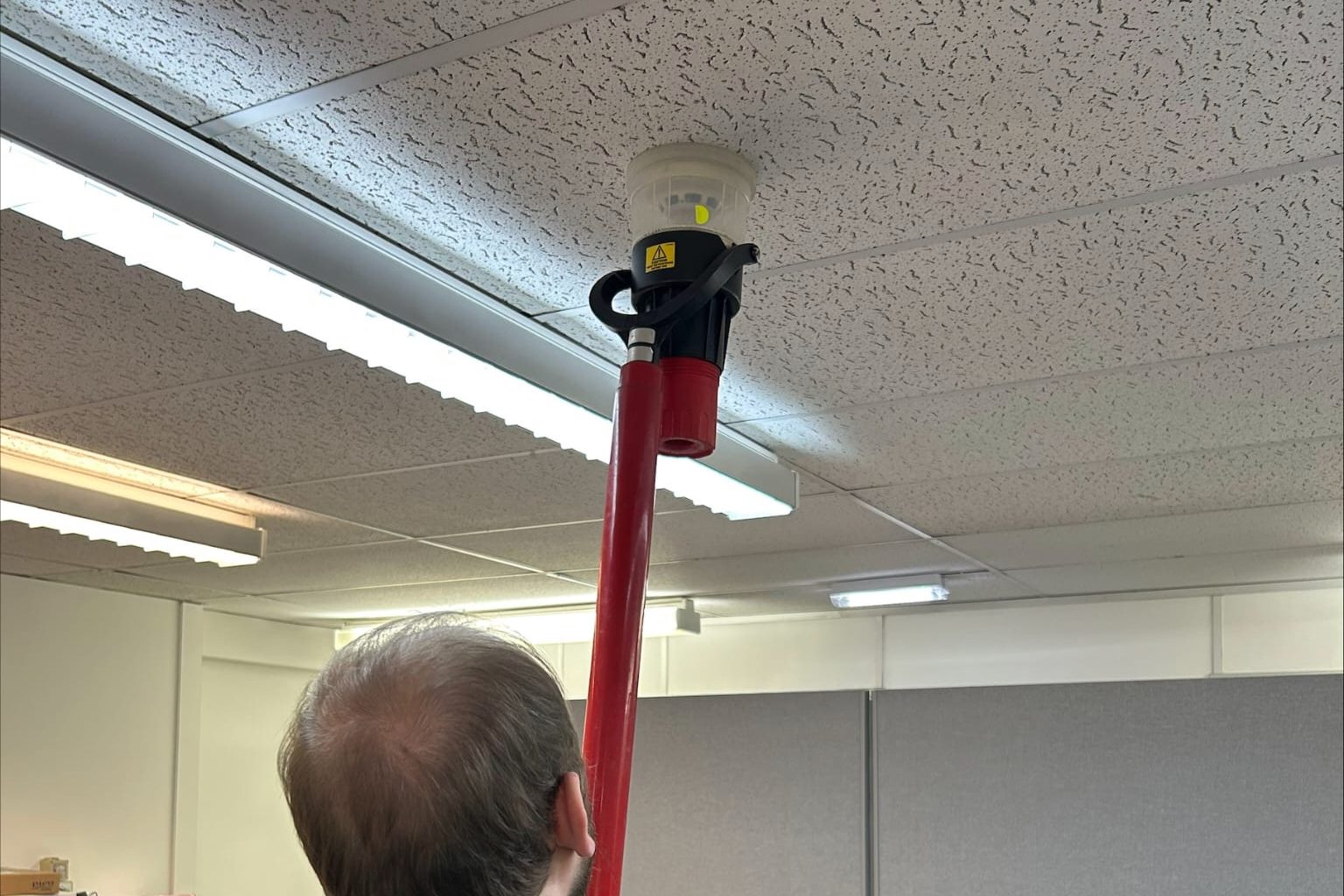
Short answer. A commercial fire alarm should be tested by someone on site every week, using a different manual call point each time. It should be inspected and serviced by a competent person about every six months. BS 5839-1:2025 allows each service to fall anywhere between five and seven months after the previous one. Over the course of each year, every detector, call point and sounder should be tested at least once. All of it should be written in the log book.
The rest of this article explains each part, what goes wrong in practice, and what happens when false alarms start to pile up.
The schedule at a glance
| How often | What | Who |
|---|---|---|
| Every week | Operate one manual call point, confirm the alarm sounds and the panel responds, reset, record it | The responsible person, or someone they appoint |
| Every time it happens | Record and investigate every false alarm | The responsible person, with the servicing company |
| About every six months (five to seven months after the last visit) | Inspection and service, ending with an inspection and servicing certificate | A competent fire alarm engineer |
| Over each year | Every detector, call point, sounder and interface tested at least once | Spread across the service visits |
| At the twelve-monthly visit | Extra items, including functional testing of smoke detectors in ventilation ducts | A competent fire alarm engineer |
The weekly test
The weekly test checks that the panel, the wiring to the call point and the sounders all work. It takes a few minutes.
- If the system signals to an alarm receiving centre, tell the centre you are about to test, so it does not treat the signal as a fire.
- Operate a manual call point with the test key. Use a different call point each week, working through them in turn, so every one gets tested.
- Check that the alarm sounds throughout the building and that the panel shows the right call point or zone.
- Keep the sounders running only briefly, so nobody mistakes the test for a real alarm.
- Reset the panel and the call point.
- Tell the receiving centre the test is over and confirm it received the signal.
- Write it in the log book: the date, the time, which call point, and whether everything worked.
Do it at roughly the same time each week, so staff learn that an alarm at that time is a test.
A practical point from our own work. A weekly test is impossible without the key that opens a call point for testing. In the last year two of our customers needed replacement call point test keys, one of them 20 and the other 11. If yours have gone, replace them before the next test.
If nobody on site can do it. The weekly test is the responsible person's duty, but it can be delegated. Some of our customers, mostly residential and mixed-use buildings with no staff on site, have us do it. Our engineers have carried out 122 weekly fire alarm tests since we moved our job records onto our current system in spring 2025. A weekly test visit typically costs £45 to £90.
The six-monthly service
BS 5839-1:2025 changed the wording on service intervals. The 2017 edition said the period between visits should not exceed six months. The 2025 edition says visits should be about six months apart, and allows each one to fall anywhere from five to seven months after the previous visit. That makes scheduling around holidays and access problems easier. It does not make a single annual visit acceptable.
At each service, a competent engineer should:
- check the log book, including the weekly tests and any false alarms since the last visit
- test a share of the detectors, call points, sounders and visual alarm devices, so every device is covered over the year
- check the panel's indicators, fault monitoring, power supplies, standby batteries and charger
- check that fire signals reach the alarm receiving centre, where the system is monitored
- check and adjust any time clock on the panel, which matters where the system has day and night modes
- test interfaces such as door holders, lift homing, smoke vents and plant shutdown
- look for changes to the building that affect the system, such as new partitions, a change of use, or a ceiling that has been lowered
- record every defect and every departure from the standard, and issue an inspection and servicing certificate
At the twelve-monthly visit, BS 5839-1:2025 adds functional testing of smoke detectors fitted in ventilation ducts.
Our two largest industrial sites are serviced four times a year. Our engineers completed over 200 routine fire alarm service visits between spring 2025 and 2026.
Every device, every year
A service visit does not always test every device. On a large system the engineer tests a proportion at each visit, and across the year every detector, call point and sounder should have been tested at least once. Ask your servicing company to show you, from their records, that this has happened. The log book should make it obvious.
Detectors also wear out. Manufacturers typically give smoke detectors a working life of around ten years. On addressable systems, the panel reports each detector's condition, and our engineers look for detectors that are old, contaminated, or reading low. In October 2025, at one site, all but two of the smoke detectors were more than ten years old, past the manufacturer's recommendation and showing low analogue values. You can expect to pay roughly £50 to replace an individual detector if done whilst the engineer is already on site.
Batteries
The standby batteries keep the system running if the mains supply fails. BS 5839-1:2025 now recognises the long-standing trade practice of writing the fitting date on the battery, so anyone can see how old it is.
Batteries come up in our engineers' service reports more than almost anything else. In 42 of the 82 service reports where our engineers wrote detailed findings between May 2025 and 2026, batteries had been replaced or were failing. On our 2024 and 2025 invoices, a fire panel battery supplied on a service visit cost under £30. In December 2025 we attended an emergency call-out to a new client where the panel's old batteries had burst. £30 could have saved several hundred pounds.
False alarms
Every false alarm should be recorded in the log book and investigated. BS 5839-1:2025 asks the user to investigate all of them, and sets thresholds for a closer look: a preliminary investigation once false alarms exceed four per 100 detectors over the previous twelve months, and an in-depth investigation for systems with more than 40 detectors averaging more than five per 100.
Fire and rescue services also keep count. In our area:
- Norfolk Fire and Rescue Service reviews premises with three or more confirmed false alarms in a rolling five-day period, or five or more in a rolling 13-week period. It already does not send an automatic emergency response to automatic fire alarms at commercial premises, offices, shops, industrial premises and similar buildings unless someone confirms a fire.
- Suffolk Fire and Rescue Service contacts or visits premises after two unwanted fire signals in four weeks, or three in 26 weeks. It can take enforcement action under the Regulatory Reform (Fire Safety) Order 2005.
These are some of the causes our engineers have traced on real call-outs for activations and faults:
- a smoke detector in a car park, full of dust and debris, which set the system off twice in a year
- an automatic air freshener in a toilet setting off the smoke detector above it
- an infestation inside a smoke detector
- a loose terminal in a call point, and a dropped termination on another, both causing faults
- oxidised wiring on a sounder in a toilet, causing the device to change address and put the panel into fault
- water getting into a stairwell and into the devices there
Resetting the panel fixes none of these. Each one was found because an engineer went looking for the cause.
What happens if the testing is not done
The legal duty is in the Regulatory Reform (Fire Safety) Order 2005, which requires the responsible person to keep fire safety equipment maintained in efficient working order. BS 5839-1 is the recognised way of showing that has been done for a fire alarm. If the log book shows no weekly tests and the last service was a year ago, that is very hard to defend to a fire safety inspector or an insurer.
It is also one of the most common things we find. Missing log books and missing zone charts appear again and again in our engineers' service reports. Our fire alarm certificates article covers what paperwork you should have.
How we can help
We service fire alarms across Norfolk, Suffolk, Cambridgeshire and the South East, and we can take on the weekly test where nobody on site can. For prices, see our fire alarm servicing cost article, or call 01603 425100. We can take over the welfare of a current alarm, resurrect an old one into a working unit, or install a brand spanking new one. Consider us your one-stop-shop.
Frequently asked questions
How often should a fire alarm be tested in the UK?
Weekly, by someone on site, operating a different manual call point each time. A competent engineer should inspect and service it about every six months.
Is it a legal requirement to test a fire alarm every week?
The law requires fire safety equipment to be maintained in efficient working order. The weekly test is how BS 5839-1, the recognised standard, says that should be done for a fire alarm. In practice, an inspector or insurer will expect to see weekly tests in the log book.
How often should a commercial fire alarm be serviced?
About every six months. BS 5839-1:2025 allows each service to fall five to seven months after the previous one.
Does every smoke detector have to be tested every year?
Yes. Over each year, every detector, call point and sounder should be tested at least once, usually spread across the service visits.
Do I need to tell anyone before testing the fire alarm?
If the system is monitored by an alarm receiving centre, tell the centre before you test and again afterwards. Tell the people in the building too, especially if the test is not at the usual time.
How often should fire alarm batteries be replaced?
When they fail a test or reach the end of their service life. BS 5839-1:2025 recognises writing the fitting date on each battery so its age is clear. Our engineers replaced or flagged batteries on around half of the service visits where they recorded detailed findings.
About the author. Dr Andrew Threadgold is Co-Owner of Hawthorne, a commercial security and fire protection company based in Norwich. The technical content of this article was reviewed by Ashley Smith, Hawthorne's lead engineer. Last reviewed 27 September 2026.
Sources: Fire Industry Association, Guide to the changes in BS 5839-1:2025. Norfolk Fire and Rescue Service, automatic fire alarms. Suffolk Fire and Rescue Service, reducing false alarms.