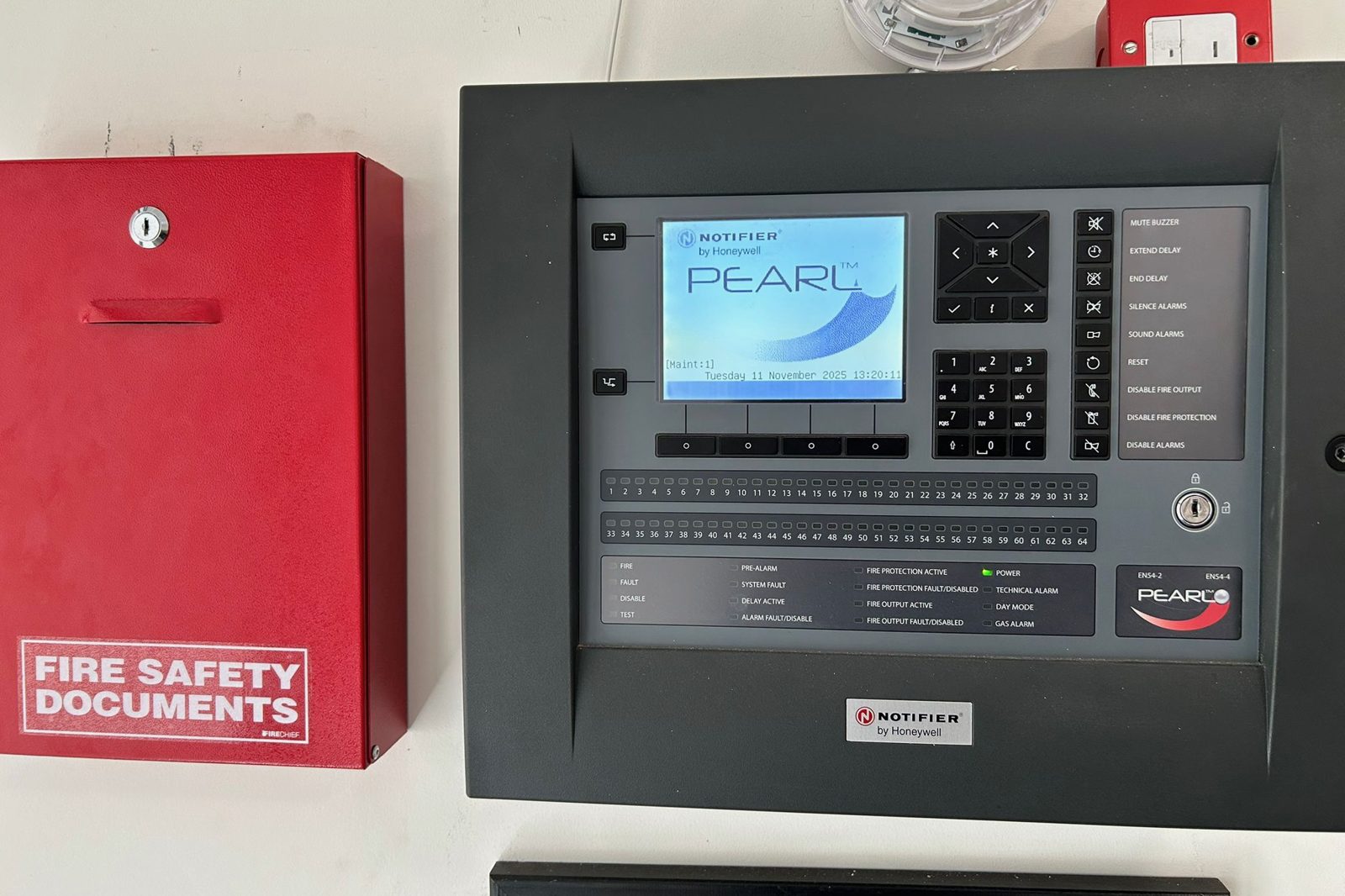
Short answer. BS 5839-1:2025 sets out model certificates for each stage of a commercial fire alarm's life: design, installation, commissioning, handover, verification, extension or modification, and inspection and servicing. Each is issued by whoever carried out that stage of the work. They should come as part of the job. In 33 months of Hawthorne invoices, from January 2024 to September 2026, we have not charged for a certificate when installing or maintaining a fire alarm.
When an insurer, a fire risk assessor or a fire safety inspector asks for "the fire alarm certificate", they usually want two things: the most recent inspection and servicing certificate, and the commissioning certificate for the system or its latest modification.
The seven certificates, and what each one proves
| Certificate | When it is issued | What it proves |
|---|---|---|
| Design | Before or at installation | The system was designed to a stated category (for example L2 or P1), with any agreed departures from the standard listed |
| Installation | When installation is complete | The system was installed to the design, using suitable cable and fixings |
| Commissioning | After every device and interface has been tested | The system works as designed, including signalling to an alarm receiving centre where there is one |
| Handover (previously called acceptance) | When the system is handed to the building's owner or occupier | The documents, drawings, log book and training have been handed over and accepted |
| Verification | Optional, if the purchaser wants an independent check | Someone independent of the installer has checked the system against the design and the standard |
| Extension or modification | After any change to an existing system | The change was designed, installed and tested properly, and the records were updated |
| Inspection and servicing | After each routine service | The system was inspected and tested, with any faults or departures from the standard recorded |
Three points about this list are often missed:
- Every change needs a certificate. Adding a detector, moving a call point, changing what happens when the alarm operates, or connecting the panel to an alarm receiving centre is a modification. The Fire Industry Association's guide to the 2025 edition adds that updating the firmware on a fire alarm control panel counts as a modification, and should have its own certificate.
- All departures from the standard must be written down. Under the 2017 edition only "major" variations had to be recorded. Under the 2025 edition every variation should be agreed, listed on the certificates and recorded in the log book. A few are classed as unacceptable, such as leaving out a zone plan at the panel in premises with more than one zone.
- Old certificates still count. If your system was commissioned on 2017 forms, those certificates remain a valid record of that work. Anything issued for the same system since 30 April 2025 should be on the 2025 forms.
What the certificates cost
They should cost nothing extra. A certificate records work that has been done, and the work is what you are paying for.
That is how we price. Our installation quotes include the design, installation and commissioning certificates, the zone plan, the log book and handover. Our maintenance visits end with an inspection and servicing certificate. Across 615 recent invoices containing fire safety work, there is not a single separate charge for a certificate.
What does carry a cost is the work required to enable us to issue a certificate:
- Routine servicing, which produces the inspection and servicing certificate. Across 52 of our contracts in the last twelve months the median charge was £304 a year, excluding VAT. Our fire alarm servicing cost article has the full breakdown.
- Taking over a system you know little about. A takeover visit combined with a full first service typically costs a few hundred pounds, and ends with an inspection and servicing certificate.
- Replacing missing documents. In 2026 a typical set of paperwork remedials, covering a zone chart, a log book and document cabinet, a proper isolation switch and call point covers, cost our customers £450 to £800.
If a quote lists "certification" as a separate line, ask what it covers. Sometimes it is a genuine extra, such as producing as-fitted drawings for a building that never had them. Sometimes it is part of the job being priced twice.
Who can issue a fire alarm certificate?
No licence is needed in law. What matters is competence. BS 5839-1:2025 defines a competent person as someone suitably trained and qualified by knowledge and practical experience, and adds that keeping that competence up to date is likely to need continuing professional development.
That creates a problem for building owners, because competence is hard to judge from outside. There are two practical checks.
Third-party certification. Schemes such as BAFE SP203-1 and LPCB LPS 1014 audit fire alarm companies and allow them to issue certificates under the scheme. SP203-1 is split into modules for design, installation, commissioning and handover, and maintenance, so check which modules a company holds for the work you need.
Experience of your kind of building. Ask what systems the company services now, how many, and in what types of premises.
Hawthorne is SSAIB certified (registration NORF034) and ISO 9001 and ISO 14001 accredited. For fire detection and alarm systems we work to BS 5839. Our fire certificates are issued by our own fire engineers on the appropriate BS 5839 form for the specific job.
Can an electrician issue a fire alarm certificate?
An electrician's electrical installation certificate under BS 7671 covers the electrical safety of the wiring. It does not cover whether the fire alarm was designed to the right category, whether the detectors are in the right places, or whether the system was commissioned to BS 5839-1. Some electricians are also competent fire alarm engineers. Not all are. Ask for evidence of fire alarm training and experience before relying on their certificate.
What we find when there are no certificates
Missing paperwork is one of the most common things our engineers record. In the year to August 2026 they wrote detailed findings on 82 fire alarm service visits across many sites. Of those reports:
- 44 recorded a zone chart that was missing, wrong or out of date
- 30 recorded no log book or no fire document cabinet
- 24 noted a missing fire risk assessment or raised it as an issue
One report simply says "no previous documentation". In those cases we cannot issue design, installation or commissioning certificates for work somebody else did, because we did not see it done. What we can do is inspect and test the system, record what we find, produce a zone chart, start a proper log book and issue an inspection and servicing certificate. That gives the building a documented starting point. Where the design itself is in doubt, the next step is a survey against the fire risk assessment.
What a fire risk assessor or insurer will ask for
In our experience the requests are usually:
- the latest inspection and servicing certificate, dated within roughly the last six months
- the log book, showing weekly tests and any false alarms
- the zone chart at the panel
- the commissioning certificate, and any extension or modification certificates since
If you can produce those four, most questions about the fire alarm are answered. If you cannot, start with a service visit.
Domestic and HMO certificates are different
Houses in multiple occupation and some smaller residential buildings are covered by BS 5839-6 rather than BS 5839-1. BS 5839-6 has its own grades (such as Grade A and Grade D1), its own categories (LD1 to LD3, PD1 and PD2) and its own certificates. The common parts of larger blocks of flats usually fall under BS 5839-1. If you are unsure which applies, your fire risk assessment should say.
Getting your certificates in order
If you have a system but not the paperwork, call us on 01603 425100 or book a service visit. We cover Norfolk, Suffolk and Cambridgeshire. For the standard behind all of this, see our BS 5839-1:2025 guide.
Frequently asked questions
How much is a fire alarm certificate?
It should be included in the cost of the work. Across 33 months of Hawthorne invoices there is no charge for a certificate. The certificate comes with the installation, the modification or the service visit that it records.
Who issues a fire alarm certificate?
The company that carried out that stage of the work: the designer issues the design certificate, the installer the installation certificate, the commissioning engineer the commissioning certificate, and the servicing company the inspection and servicing certificate.
How often should I get a new fire alarm certificate?
You should receive an inspection and servicing certificate after each routine service, which BS 5839-1:2025 recommends roughly every six months. You should also receive an extension or modification certificate after any change to the system.
Do I need a new certificate after a firmware update?
Yes. The Fire Industry Association's guidance on BS 5839-1:2025 states that updating the firmware of a fire alarm control panel is a modification and needs a certificate.
Are my 2017 fire alarm certificates still valid?
Yes, as records of the work done at the time. Certificates for new work on the same system since 30 April 2025 should be on BS 5839-1:2025 forms.
About the author. Dr Andrew Threadgold is Co-Owner of Hawthorne, a commercial security and fire protection company based in Norwich. The technical content of this article was reviewed by Ashley Smith, Hawthorne's lead engineer. Last reviewed 27 September 2026.
Sources: Fire Industry Association, Guide to the changes in BS 5839-1:2025. IET Wiring Matters, Key changes to BS 5839-1:2025. BAFE, fire detection and fire alarm systems.